

Today’s bake came with a small revelation: trying a new recipe paid off in the best possible way.
I went all in with 100% stone-milled bread flour from Ground Up, and the result? A loaf that tastes like bread actually has something to say. Deep, nutty, almost a little rebellious compared to the polite, well-behaved loaf you get from straight King Arthur bread flour. And yes, I’ll say it again because it deserves it: the taste is absolutely great.
 Now, visually, things took a different turn. The loaf didn’t rise quite as high as my usual KA-based bake. Instead, it spread a bit more, going for a broader, more relaxed profile. Not a failure—just a different personality. And frankly, it was expected. Stone-milled flour behaves differently, and it doesn’t care about your aesthetic expectations of tall, Instagram-ready loaves.
But here’s the twist: despite the wider shape, the ear came out beautifully. Crisp, proud, and exactly where it should be. So no complaints on that front.
What this bake really drives home is something I’ve suspected for a while: flavor lives in complexity. The more you move away from ultra-refined flour and bring in whole grain components—whether through stone-milling, whole wheat, rye, or a blend of them—the more your bread starts to develop character. That slightly “boring” note from a 100% KA bread flour loaf isn’t a flaw, it’s just… incomplete.
Don’t get me wrong, King Arthur still has its place in my kitchen. It’s reliable, predictable, and delivers consistent results. But this bake proves that stepping outside that comfort zone—whether by switching flours or blending them—opens the door to something far more interesting.
And that’s where things get fun. Because now the question isn’t how to “fix” the spread. The question is how to work with it… or even better, how to build on this flavor without losing what made this loaf so good in the first place.
From Roller-Milled Precision to Stone-Milled Character
The key difference starts with how the flour is made. King Arthur bread flour is roller-milled, a modern process that separates the wheat kernel into its components—endosperm, bran, and germ—and then recombines only what’s needed for consistency. The result is a very clean, predictable flour with a uniform particle size and a tightly controlled protein content.
Stone-milled flour, on the other hand, is ground in a single pass, preserving the full character of the grain—but in the case of Ground Up’s bread flour, it doesn’t stop there. They sift it to an “83% extraction,” meaning a portion of the coarser bran is removed after milling. So while it’s not a fully whole grain flour, it still retains much of the germ and finer bran, giving you a flour that sits right between whole wheat and white—more natural and flavorful than refined flour, but more manageable in dough than a true whole grain.
That difference shows up immediately in structure. Roller-milled flour like KA produces strong, elastic gluten networks because the bran and germ have largely been removed or minimized. That gives you height, strength, and that classic upward spring. Stone-milled flour still contains bran and germ, which act like tiny blades cutting through gluten strands. The result is a dough that feels slightly less elastic and more fragile, which explains why your loaf spreads more instead of rising tall. It’s not weaker in a bad way—it’s just playing by different rules.
Then there’s water absorption. Stone-milled flour tends to absorb more water, but not always in a predictable way. The bran and germ soak up moisture like sponges, often more slowly than the refined endosperm. That can make the dough feel looser early on and tighter later, sometimes catching you off guard if you’re used to the consistency of KA flour. With roller-milled flour, hydration behaves more consistently, which is one of the reasons it’s favored for repeatable results.
And finally, flavor—this is where stone-milled flour simply wins. Because it retains the full wheat kernel, including the oils and minerals in the germ and bran, it delivers a depth of flavor that refined flour just can’t match. You get nuttiness, a slight sweetness, even subtle earthy notes that evolve during fermentation. KA flour provides a clean, neutral base, which is great when you want control. But stone-milled flour brings its own voice to the table—and once you notice it, it’s hard to go back without feeling like something’s missing.
The Recipe That Delivered
Now let’s get into the details—the part where things either fall apart… or come together beautifully.
This one came together.
I went with 500g of stone-milled bread flour, paired with 400g of warm water, landing me at 80% hydration. Add 100g of sourdough starter (a solid 20%), and you’ve got a dough size that fits perfectly into a standard oval banneton—no guesswork, no overflow, no regret.
I started with a one-hour fermentolyse, giving the flour and water (and starter) time to get acquainted before introducing salt. After that, I added 10g of salt and moved into structure-building mode: two rounds of stretch & fold, followed by two coil folds. Each session was spaced out with a relaxed 30-minute break—enough time to let the dough settle without forgetting you’re baking.
Bulk fermentation ran for 6.5 hours at 75°F (24°C), and here’s where I cheat a little—in the best possible way. I use a temperature-controlled proofing box. It takes the seasonal mood swings of the kitchen out of the equation and replaces them with consistency. Highly recommended if you’re tired of guessing games.
After bulk, the dough went into the fridge for an overnight rest—about 15 hours. Long enough to develop flavor, short enough to keep things on schedule.
Baking happened the next morning in a cast iron baking pan, essentially my stand-in for a Dutch oven. I preheated to 480°F (250°C), baked 20 minutes covered, then another 20 uncovered. I like my loaves bold and dark—borderline dramatic. If that’s not your thing, dropping the temperature to 450°F (230°C) will give you a lighter, more polite crust.
Same dough, different personality. That’s the beauty of it.
Tweaking the Rise Without Touching the Recipe
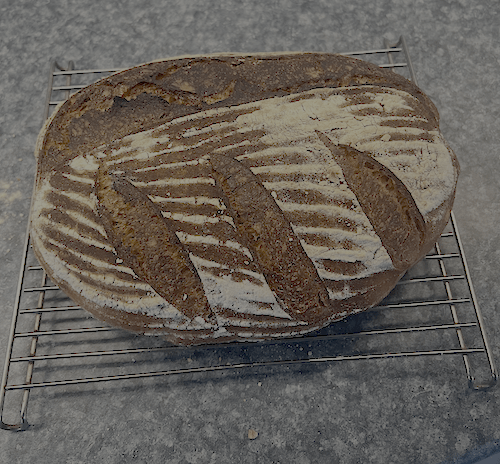 After a late breakfast—or let’s be honest, an early lunch consisting of four generous slices of this new bread with cream cheese—I did what every baker eventually does after a successful loaf: I started thinking about how to make it just a little bit better.
The goal is simple. I want a bit more rise without sacrificing that incredible flavor. The obvious idea would be to blend in a portion of King Arthur bread flour for extra strength, but that feels like a compromise—and after tasting this loaf, I’m not willing to give up any of that character.
So instead, I’m looking at the process.
First adjustment: I’ll shorten the bulk fermentation by about 30 minutes. Stone-milled flour tends to ferment faster due to the higher mineral and enzyme content from the bran and germ. Letting it go too long can push the dough slightly past its optimal strength, leading to more spread and less upward lift.
Next, I’ll reduce the cold retard to around 12 hours. A shorter time in the fridge helps preserve more of the dough’s remaining structure and fermentation potential. In other words, the dough goes into the oven with a bit more energy left, which can translate into better oven spring—while still developing plenty of flavor overnight.
Finally, I’ll experiment with scoring. Instead of a deep, aggressive cut, I’ll go a bit more restrained and place the score slightly higher on the loaf. The idea is to guide the expansion upward rather than letting it relax outward too easily.
Same ingredients. Small adjustments. That’s where things get interesting.
I’ll follow up with the results.
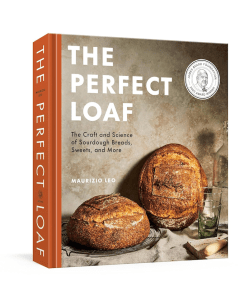 The Perfect Loaf: The Craft and Science of Sourdough Breads, Sweets, and More: A Baking Book
Maurizio Leo’s blog The Perfect Loaf has become one of the most trusted destinations on the internet for anyone learning sourdough baking. With his debut cookbook, he brings that same careful attention to detail, clear instruction, and generous teaching style into a comprehensive guide that walks readers through the essential foundations of sourdough—while also giving them the tools and confidence to go further.
The book begins with the fundamentals: understanding sourdough starters, learning how fermentation shapes flavor and texture, and mastering the techniques that turn simple ingredients into consistently excellent bread. From there, Leo guides readers step by step through a wide range of recipes designed to build both skill and intuition.
The recipes cover many of the breads home bakers love most, including:
Essential freeform loaves: Simple Sourdough, Rosemary & Olive Oil Sourdough, Extra-Sour Sourdough, Cranberry & Walnut, Demi Baguettes
Pan loaves: Everyday Sandwich Bread, Naturally Leavened Brioche, German Whole Rye, Honey Whole Wheat Sandwich Bread
Pizza and flatbread: Roman-Style Pan Pizza, Focaccia, Naan, Flour Tortillas, Pita
Buns and rolls: Soft Dinner Rolls, Potato Buns, Ciabatta Rolls, English Muffins, Bagels
Sweet bakes: Weekend Cinnamon Rolls, Italian Doughnuts, Summer Fruit Sourdough Crostata, Banana Bread, Cinnamon Babka
True to Leo’s teaching philosophy, beginners are supported throughout the entire process. Troubleshooting sections and helpful sidebars address common questions such as how to store a sourdough starter long-term, how to work with baker’s percentages, and how to recognize—and fix—common bread problems.
At the same time, experienced bakers will appreciate the deeper explorations into fermentation science, dough development, and the subtle adjustments that allow bakers to refine their technique. Topics such as hydration, ingredient ratios, freshly milled grains, and specialty flours encourage readers to experiment and gradually develop their own “baker’s intuition.”
Whether you are baking your first loaf or refining your craft, The Perfect Loaf serves as both a practical handbook and an inspiring companion in the kitchen. More information…
