

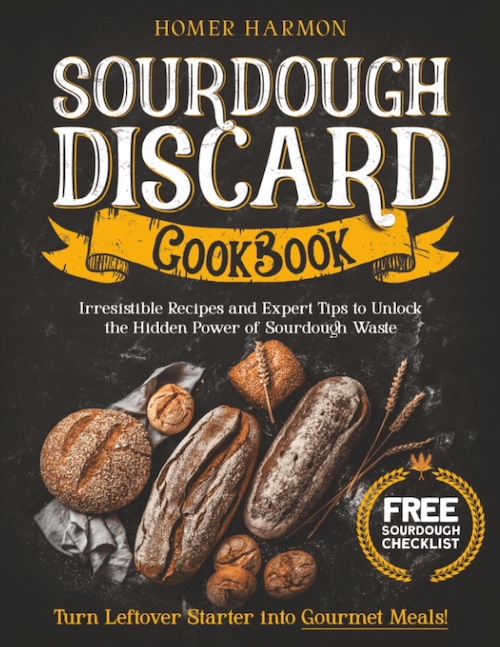
 If you bake sourdough regularly, you already know the routine: feed the starter, watch it come alive—and then discard a portion to keep things balanced. It’s practical, necessary, and, if we’re honest, a little painful.
Because every time you scoop that discard into the trash, you’re not throwing away waste. You’re throwing away flavor, fermentation, and possibility.
Let’s call it what it really is: baking gold.
Rethinking “Discard”
The word itself is misleading. It suggests something spent, something useless. But sourdough discard is simply unfed starter—flour and water that has already gone through partial fermentation. That means it carries depth of flavor, subtle acidity, and enzymatic activity you cannot replicate by mixing fresh ingredients alone.
In other words, it’s not the end of a process. It’s the beginning of another one.
Once you stop seeing discard as a byproduct and start treating it as an ingredient, your kitchen opens up in ways most sourdough bakers never explore.
What You’ve Been Missing
Most bakers focus entirely on the loaf. And that’s fair—there’s something deeply satisfying about pulling a well-risen, crackling boule from the oven. But in that process, they overlook a steady stream of usable starter that could be transformed into everyday food.
Not complicated, show-off baking. Real food.
Pancakes that carry a gentle tang and crisp edges. Crackers that actually taste like something. Flatbreads, muffins, cakes—each one improved by fermentation that has already begun before you even mix the dough.
And perhaps most importantly, these recipes are forgiving. Discard doesn’t demand precision. It invites experimentation.
From Waste to Ingredient
Using discard is not about squeezing value out of scraps. It’s about recognizing that fermentation has already done part of the work for you.
That slight acidity? It enhances flavor.
That breakdown of flour? It improves texture.
That living culture? It brings complexity without effort.
Even older discard—something many would hesitate to use—can still contribute beautifully when handled correctly. In fact, the more mature the discard, the more character it can add, especially in recipes where structure doesn’t depend on active fermentation.
The result is food that tastes intentional, not improvised.
A Different Kind of Baking
There’s also something quietly satisfying about reducing waste in a way that doesn’t feel like sacrifice. You’re not forcing yourself to reuse leftovers out of obligation. You’re doing it because the result is genuinely better.
You buy less flour. You throw away less food. And you expand your range as a baker without adding complexity to your process.
It’s a shift in mindset as much as technique.
What a Discard Cookbook Should Do
A good sourdough discard cookbook doesn’t just give you recipes. It changes how you think about your starter.
It should show you how to:
– Turn discard into everyday staples without overcomplicating the process
– Build flavor using what you already have instead of starting from scratch
– Adjust recipes based on how fresh—or how old—your discard is
– Troubleshoot texture, acidity, and consistency without guesswork
– Move beyond bread and into a broader, more versatile kitchen routine
Most importantly, it should make you stop hesitating when you look at that jar in your fridge.
Because that jar isn’t a problem to manage. It’s a resource.
A Final Thought
You will still discard some starter. That’s part of maintaining a healthy culture, and there’s no need to pretend otherwise.
But the difference is this: you’ll no longer see it as something to get rid of.
You’ll see it as something to use.
And once you make that shift, your sourdough routine stops being a cycle of feeding and wasting—and becomes a continuous loop of creation. More information…
