
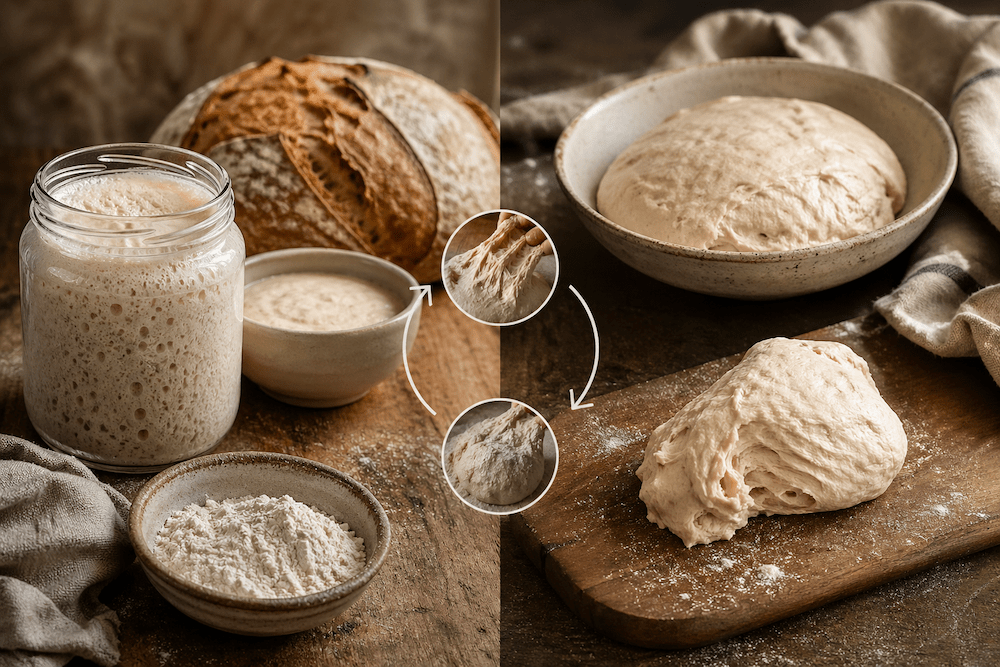
I’m still fascinated by the history of sourdough—and far from done exploring it—so I keep wandering down the rabbit hole of YouTube videos and obscure online posts. Not everything from medieval baking translates neatly into a modern kitchen (unless you happen to have a wood-fired oven and a few spare apprentices), but every now and then, you stumble across a small detail that’s actually worth bringing back to life.
So I keep watching, reading, and—perhaps most importantly—filtering. Because let’s be honest: the internet is overflowing with “ancient baking wisdom,” and not all of it deserves your flour.
And then, in one of those history-focused YouTube channels—of which there are many, and of wildly varying reliability—I heard a statement that made me pause:
“Levain just means old dough.”
It sounds plausible. It sounds traditional. It even carries a certain rustic charm—like some medieval baker casually saving a piece of yesterday’s dough, tossing it into today’s batch, and calling it a method.
So naturally, you try it.
And for a while, everything works beautifully.
The dough rises. The bread tastes great. You begin to wonder whether you’ve uncovered a simpler, more efficient way to bake—one that avoids the whole routine of feeding and discarding a starter.
And then, almost without warning, the system begins to fade. The dough loses strength. Fermentation slows. The bread just doesn’t behave the way it used to.
What changed?
To understand that, we need to start with a simple but important clarification.
The word “levain” comes from the French verb lever, meaning “to rise.” In baking terms, it refers to a leavening culture—something specifically maintained and prepared to make dough rise. A levain is not leftover dough. It is a mixture of flour and water that has been fermented with wild yeast and bacteria, and—this is crucial—it is refreshed before use. It is designed to be active, strong, and ready to perform.
Old dough, or pâte fermentée, is something else entirely. It is a piece of already mixed dough that has completed or nearly completed its initial fermentation. It contains salt. It has developed gluten. It has already gone through the biological processes that define fermentation. When you carry it forward into the next batch, you are not building a new system—you are continuing an old one.
At first glance, the two methods seem similar. Both involve fermentation. Both involve carrying something forward from a previous bake. Historically, the line between them was not always sharply defined. Bakers reused fermented material in various forms long before modern terminology existed. It is easy to see how someone could collapse these ideas into a single, simplified claim.
But in practice, the difference becomes very real—and very noticeable.
Let’s follow the logic of the experiment many bakers eventually try. You mix a sourdough. Before baking, you set aside a small piece. The next time you bake, you combine fresh flour and water with that piece of old dough. Then you repeat the process again and again.
On paper, this seems like a perfect system. You are adding fresh flour each time, so it feels like a kind of refreshment. You avoid discard entirely. You maintain continuity from one bake to the next. It feels efficient, even elegant.
And in the beginning, it works.
During the first few cycles, the microbial population is still strong. The yeast and bacteria are active and reasonably balanced. There is enough residual energy in the system—enough available sugars and biological momentum—to support fermentation. The dough rises well. The flavor is often excellent, sometimes even deeper and more mature than expected.
But fermentation is not static. It is a moving system, and over time, several quiet changes begin to accumulate.
Salt, which is present in the dough from the start, continues to exert its influence. It slows microbial activity—particularly yeast. The readily available sugars in the dough are gradually consumed. As fermentation progresses, acids build up, making the environment increasingly hostile. Yeast, which is more sensitive to these conditions than bacteria, begins to lose its edge. The balance shifts.
What you are left with is still a living system, but it is no longer a thriving one. It is aging.
This is where an important distinction comes into focus. Old dough does ferment when you store it for a day. In fact, fermentation continues the entire time. But it is not a process of renewal—it is a process of continuation. The dough is moving forward along the same trajectory it began the day before. It is not being reset.
A levain, by contrast, is deliberately refreshed. When you feed it with fresh flour and water, you are not just adding nutrients—you are creating an environment that favors growth. You dilute accumulated acids. You provide new sugars. You give the yeast and bacteria a chance to expand and rebalance. Each refreshment is, in effect, a controlled restart.
This is why levain grows stronger with proper maintenance, while old dough gradually weakens.
It’s also why your instinct—that adding fresh flour during the next mix should count as a refreshment—is only partially correct. Yes, you are introducing new material into the system. But you are doing so within the context of a fully developed dough that already contains salt, already carries the byproducts of fermentation, and has already exhausted much of its readily available energy. You are diluting the system, not resetting it.
The result is a kind of closed loop. It sustains itself for a time, but it carries forward not only the beneficial organisms, but also the limitations and accumulated stress of previous cycles. Without a true refresh, those limitations eventually dominate.
Interestingly, this doesn’t mean the method is flawed in principle. It simply has boundaries.
Historically, bakers who relied on old dough worked under very different conditions. They often baked daily, or close to it. The intervals between bakes were short enough that the system never had time to degrade significantly. They used larger portions of carryover dough, which helped maintain fermentation strength. And perhaps most importantly, they adjusted intuitively. If the dough seemed sluggish, they compensated—sometimes without formalizing what they were doing.
In that context, the method worked. Not because old dough is equivalent to levain, but because the conditions supported its limitations.
For a modern home baker, those conditions are harder to replicate. Baking once or twice a week introduces longer gaps. Refrigeration slows activity further. Smaller carryover amounts dilute the system more aggressively. Over time, the decline becomes noticeable—and eventually unavoidable.
None of this diminishes the value of old dough. Even after a day, even in a slightly weakened state, it contributes something meaningful. The flavor it brings can be rich, rounded, and complex in a way that fresh dough alone cannot achieve. It can improve crumb structure. It can add a subtle depth that elevates the final loaf.
But it is not a reliable engine for long-term leavening.
That role still belongs to levain.
A useful way to think about the relationship is this: levain is the system you build and maintain to generate strength. Old dough is something you carry forward to enhance character. One is designed for renewal. The other is designed for continuity.
And this brings us back to the original claim.
“Levain just means old dough.”
It’s a statement that sounds appealing because it simplifies something complex. It wraps history, technique, and biology into a single neat idea. But when you actually put it into practice—when you follow the logic all the way through—it doesn’t hold up.
What you discovered in your own baking is the more important truth. Old dough can keep something alive. For a while, it can even make it shine. But without true refreshment, it cannot keep it strong.
And in bread baking, strength is what carries everything else.
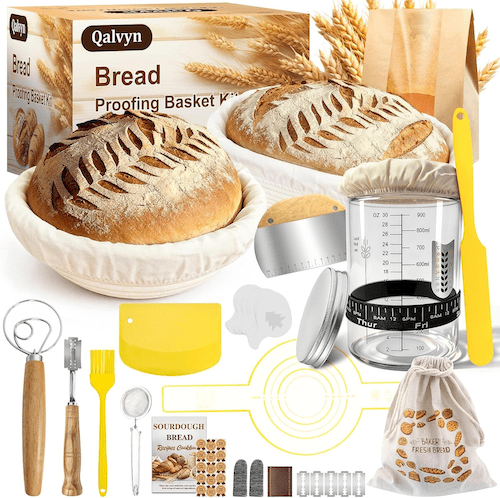 Sourdough Starter Kit – Sourdough Bread Baking Supplies
This complete sourdough starter kit includes everything you need to start baking right away, from a 9-inch round and 10-inch oval proofing basket to a starter jar, dough whisk, bread lame with blades, scrapers, flour duster, silicone bread sling, brush, bread stencils, bread bags, and a user manual—no guesswork required.
The banneton baskets are made from high-quality Indonesian rattan with a smooth, splinter-free finish that helps maintain dough shape while creating classic spiral patterns. Each includes a linen liner for easy release and cleaning, making them practical for regular use.
The 34 oz glass starter jar features clear measurement markings, and all silicone tools are made from food-grade materials for safe, everyday baking. The included tools are designed to simplify the entire process, from mixing to baking, while the bread lame features a safer handling design. As always, blades should be handled with care.
Whether you’re just starting out or adding to your setup, this kit offers a practical and well-rounded solution for baking homemade sourdough with confidence. More information…
