

If you’ve ever compared a bag of whole wheat flour from King Arthur Baking Company with a stone-ground flour from Ground Up Grain, you might assume the difference is mostly marketing. After all, both claim to be “whole grain,” both come from the same wheat kernel, and both promise better flavor than standard white flour.
But once you start baking with them—especially in sourdough—you realize quickly that they behave like entirely different ingredients.
The difference begins with how the grain is milled. Roller milling, the method used by most commercial producers, separates the wheat kernel into its components: bran, germ, and endosperm. These parts are then recombined in carefully controlled proportions. The result is consistency. Every bag behaves almost exactly the same, which is why flours like King Arthur’s whole wheat are so predictable in the bowl and in the oven.
Stone milling takes a different approach. The entire grain is crushed in one pass, without separating anything. What ends up in your flour is a more direct expression of the original wheat—less engineered, more intact. That sounds romantic, and to some extent it is, but it also means variability. The flour contains particles of different sizes, from fine powder to small flakes of bran, and that changes how it behaves.
The first thing you’ll notice is texture. Roller-milled whole wheat is fine and uniform. It mixes smoothly, develops gluten more easily, and generally behaves the way you expect. Stone-ground flour feels different from the start—slightly coarse, sometimes uneven. Those larger particles don’t just sit there quietly. They interfere with gluten formation, acting almost like tiny blades that weaken the structure of the dough. The result is often a loaf that spreads a bit more and rises a bit less, even when everything else is done right.
But then comes the reason many bakers put up with that trade-off: flavor. Stone-ground flour has depth. It’s richer, more aromatic, sometimes even slightly sweet in a way that standard whole wheat rarely achieves. That comes from the way the germ and its natural oils are preserved in the milling process. You’re tasting more of the grain itself, not just a reconstructed version of it.
That same quality affects how the flour handles water. Stone-ground flour tends to absorb more, and it does so less predictably. A dough that feels perfectly balanced with roller-milled whole wheat might feel loose or overly hydrated when you switch to stone-ground. At the same time, fermentation tends to move faster. The nutrients are more accessible, the microorganisms more active. What works as a six-and-a-half-hour bulk fermentation with one flour might need to be shortened when using the other.
There’s also the matter of shelf life. Stone-ground flour contains more of the wheat’s natural oils, which makes it more flavorful—but also more perishable. It doesn’t sit on a shelf for months without consequences. Roller-milled flour, by contrast, is designed for stability as much as performance.
All of this already creates a meaningful distinction in wheat baking. But when you move into rye, the same differences become far more dramatic.
Rye is not wheat. It does not rely on gluten to build structure. Instead, it depends on a network of complex carbohydrates and starch gels. That means the dough doesn’t have the same internal strength to compensate for inconsistencies in the flour. With wheat, coarser particles weaken the dough slightly. With rye, they can define the outcome.
Roller-milled rye flour, like the typical offerings from King Arthur, is fine, uniform, and often categorized by how much of the grain is included—light, medium, or dark. It behaves in a relatively controlled way, which is why it’s often used in mixed-flour loaves where wheat still provides most of the structure.
Stone-ground rye, on the other hand, is much closer to the original grain. It absorbs more water, becomes stickier, and transforms the dough into something that feels less like dough and more like paste. Handling it requires a different mindset entirely. You don’t knead it in the traditional sense. You shape it, guide it, and try not to fight it.
Fermentation becomes more sensitive as well. Rye contains enzymes that actively break down starch into sugars. In a controlled environment, this is beneficial—it feeds fermentation and enhances flavor. But with stone-ground rye, those enzymes are more active and less restrained. If fermentation goes too far, the structure can collapse, leaving you with a dense or even gummy crumb.
This is why traditional rye baking relies so heavily on sourdough. The acidity isn’t just there for taste; it regulates enzyme activity and stabilizes the dough. Without that balance, the flour can quite literally work against you.
And yet, when everything comes together, the payoff is unmistakable. Stone-ground rye delivers a depth of flavor that is difficult to replicate with more processed flours. It’s darker, more complex, more aligned with what many people remember from traditional European breads.
In the end, the choice isn’t about which flour is “better.” It’s about what you value in your baking.
If you want reliability, predictability, and ease of handling, roller-milled flours like those from King Arthur give you exactly that. They behave consistently, respond well to standard techniques, and make it easier to dial in your process.
If you’re after character—flavor, variation, and a closer connection to the grain itself—stone-ground flours like those from Ground Up offer something different. They demand more attention, sometimes more compromise in structure, but they reward you with complexity that is hard to achieve otherwise.
Many experienced bakers eventually settle somewhere in between, blending flours to balance structure and flavor. It’s not a compromise so much as a deliberate choice: taking the strengths of both approaches and shaping them into something that fits your own style of baking.
And that, more than anything, is the real takeaway. Flour isn’t just an ingredient. It’s a decision.
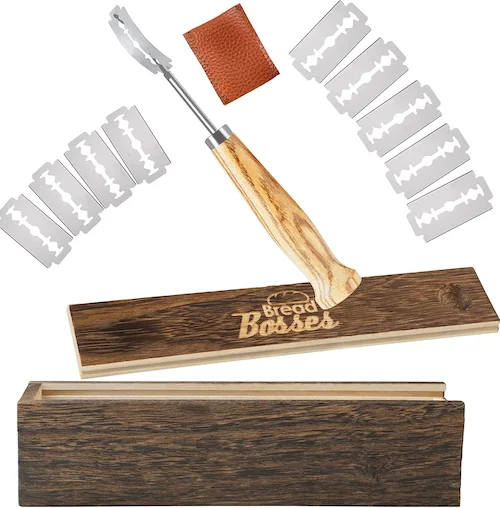 Sourdough Bread Lame – Precision Scoring Tool for Artisan Baking
Achieve clean, controlled cuts that allow your dough to expand exactly where it should. This bread lame creates sharp, deep slashes with ease—far superior to even the sharpest kitchen knife—helping your loaves bake evenly while giving them that classic artisan finish.
Designed for comfort and control, the ergonomic wooden handle fits naturally in your hand, allowing for smooth, confident scoring. Whether you’re making a single bold cut or multiple decorative slashes, the tool responds precisely to your movement, making it easy to achieve consistent results every time.
Crafted from high-quality wood, the handle is both durable and safe to use. The thoughtful design keeps your fingers away from the blade while maintaining full control, so you can focus on technique rather than handling. Once you start using it, scoring becomes second nature—clean, precise, and repeatable.
Unlike many alternatives, this lame features a smooth handle design without grooves or rings that trap flour and dough residue. The result is easier cleaning and a more hygienic tool, especially during frequent use.
The set includes 10 ultra-sharp, double-edged blades that are simple to replace and rotate, allowing you to use all corners before switching to a new blade. A wooden storage box keeps everything organized and protected, while a protective blade cover ensures safe handling and storage.
A practical and thoughtful tool for any sourdough baker—whether you’re refining your technique or simply want better, more reliable results. More information…
