
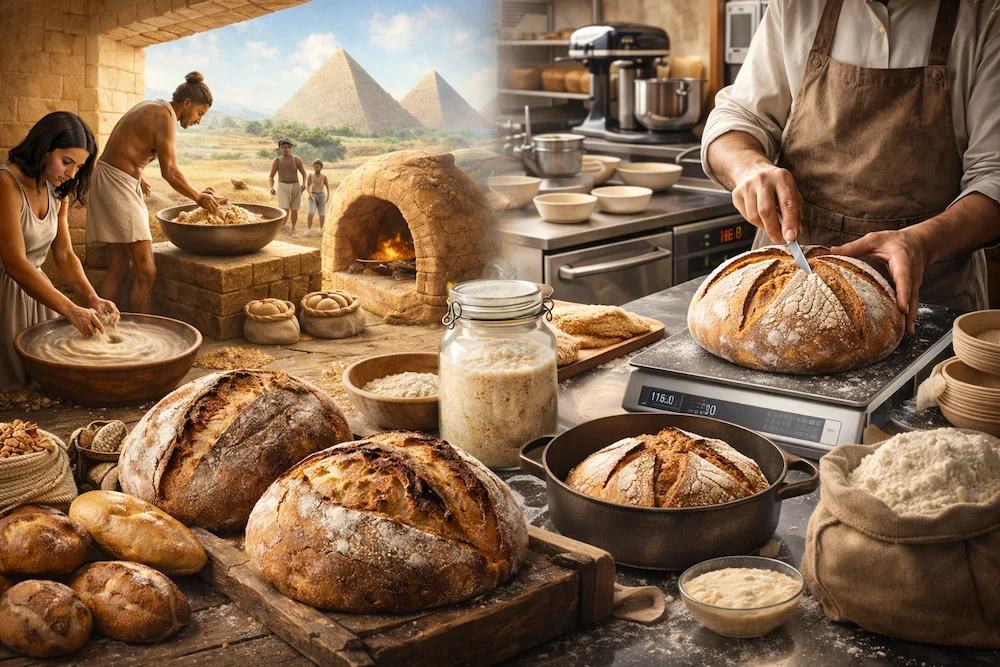
Sourdough isn’t trendy. It just looks that way right now.
In reality, it’s one of the oldest food technologies humanity ever stumbled into—right up there with fire and fermented beverages. What makes sourdough fascinating is that nobody actually “invented” it. It simply happened… and people were smart enough to keep doing it.
This is just a very brief overview of a topic that has filled entire libraries. Think of it as a quick reference rather than a deep dive.
In future posts, I’ll circle back to specific periods—especially ancient baking methods—and how they quietly shaped what we do in a modern kitchen. Because while today’s sourdough culture likes to think it’s innovative, most of it is just a rediscovery of what bakers figured out thousands of years ago.
Let’s take a walk through time—no lab coat required.
Ancient Beginnings: Bread by Accident
Somewhere around 4,000–5,000 years ago, in ancient Egypt, a bowl of flour and water sat around a little too long.
Instead of going bad, it came alive.
Wild yeast and bacteria from the air colonized the mixture, producing gas and acids. When baked, the result was lighter, tastier, and easier to digest than flatbread.
That was sourdough.
What followed:
- Egyptians refined baking into a craft
- They built some of the first ovens
- Bread became a cornerstone of daily life and even currency
No one knew what yeast was. They just knew: this works—don’t mess with it.
Greece & Rome: Bread Becomes Culture
The Greeks and Romans took sourdough and ran with it.
They turned bread into:
- A profession (yes, professional bakers existed)
- A science (well… early science)
- A social marker (different breads for different classes)
Romans even:
- Used multiple starter methods
- Documented baking techniques
- Created large-scale bakeries
Bread was no longer survival—it was identity.
The Middle Ages: Quiet Persistence
After the fall of Rome, things got… less organized.
But sourdough didn’t disappear. It quietly stayed alive in:
- Households
- Villages
- Monasteries
Key traits of this era:
- Communal ovens were common
- Starters were passed down (literally family heirlooms)
- Baking was practical, not romantic
No one was chasing an open crumb. They were chasing calories.
The Gold Rush Era: Sourdough Goes West
Now it gets interesting.
During the 1800s, especially in places like Alaska and San Francisco, sourdough became essential again.
Why?
Because commercial yeast didn’t exist yet—or wasn’t available.
Miners (nicknamed “sourdoughs”) would:
- Carry their starter everywhere
- Sleep with it to keep it warm
- Treat it like a survival tool
San Francisco, in particular, became famous for its tangy sourdough—thanks to the unique local bacteria (yes, the environment matters).
Industrial Revolution: The Fall (Sort Of)
Then came a major shift.
Commercial yeast entered the scene.
Suddenly:
- Bread became faster to produce
- Flavor became less important than efficiency
- Uniformity replaced individuality
Result:
- Sourdough declined sharply
- Soft white bread took over
- Baking moved from homes to factories
Sourdough didn’t vanish—but it became niche.
The Modern Revival: Back to Flavor
Fast forward to today—and sourdough is back.
Why?
Because people realized:
- Bread can actually taste like something
- Fermentation improves digestibility
- Slow processes produce better results
And yes… the internet helped (for better or worse).
Modern sourdough culture includes:
- Home bakers obsessing over hydration percentages
- Instagram-worthy scoring patterns
- Endless debates about “the perfect crumb”
But beneath all that noise, the core truth hasn’t changed:
It’s still just flour, water, salt, and time.
So What’s the Big Deal?
Sourdough has survived:
- Empires rising and falling
- Industrial shortcuts
- Modern food trends
Because it solves a simple problem beautifully:
How do you turn grain into something alive, nourishing, and deeply satisfying?
And it does so without:
- Commercial additives
- Artificial shortcuts
- Complicated tools
Just a living culture and a bit of patience.
A Final Thought (Without Getting Philosophical)
Every time you bake sourdough, you’re participating in a process that’s thousands of years old.
Not recreating it.
Continuing it.
And honestly—that’s a lot more interesting than chasing the perfect ear.
 Sourdough Culture: A History of Bread Making from Ancient to Modern Bakers
The essential story of bread baking—and how sourdough became a global phenomenon.
Sourdough has always been more than food. It fueled the labor that built the Egyptian pyramids. It helped the Roman Empire maintain social order through the distribution of daily bread. And in more recent times, during the COVID-19 pandemic, it reemerged as a global ritual—part comfort, part distraction, part quiet rebellion against uncertainty.
In Sourdough Culture, environmental science professor Eric Pallant makes a compelling case: throughout history, sourdough has been about one thing above all—survival.
Spanning more than six thousand years, the book traces the origins of sourdough from the Fertile Crescent through Europe and across the globe. Pallant blends historical narrative with accessible science, explaining how natural fermentation shaped not just bread, but entire societies. Along the way, he connects sourdough to figures such as Plato, Pliny the Elder, Louis Pasteur, Marie Antoinette, Martin Luther, and Antonie van Leeuwenhoek—while also giving long-overdue attention to the countless unnamed bakers who sustained everyday life: Roman professionals, medieval households, Gold Rush miners, and generations of anonymous hands that kept the process alive.
Each chapter is paired with recipes drawn from different eras and regions, offering a practical link between past and present. The result is a book that moves easily between history, science, and the kitchen.
More than anything, Sourdough Culture tells the story of a simple process that quietly shaped the world—and still does. More information…
