
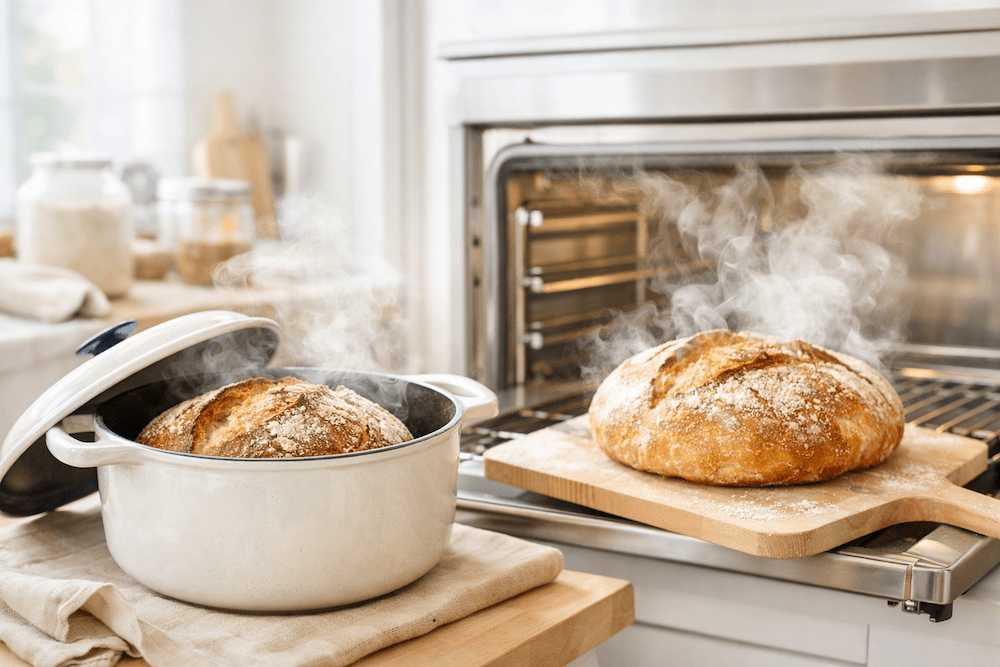
There’s a moment, just after your dough hits the oven, when everything that happened over the past 24 hours either pays off—or quietly falls apart. The dough expands, the score opens, and the loaf begins to rise. Or… it doesn’t.
The difference often comes down to something you can barely see and can’t really measure in a home oven: steam.
Let’s take a closer look at how steam controls oven spring and crust development—and why mastering it can completely change your bread.
The role of oven spring
Oven spring is the rapid expansion of the dough during the first phase of baking. It happens in a narrow window—typically the first 10 to 20 minutes—and it’s driven by three forces:
- Residual yeast activity producing a final burst of gas
- Expansion of gases already trapped in the dough
- Water inside the dough turning into steam
This is the moment when your loaf gains its final shape and volume. After that, the crust sets and expansion stops.
Which brings us to the real question: what determines how long that expansion window stays open?
Side note: While I refer to a “good oven spring,” let’s keep one thing in perspective: oven spring is mostly about appearance, not taste.
Somewhere along the way, parts of the baking world turned oven spring into a kind of performance metric—if your loaf doesn’t rise like a cathedral and split open with dramatic flair, it’s treated as a failure. That’s a bit like judging a meal by how photogenic it is rather than how it actually tastes.
Yes, a strong oven spring often points to a well-developed, airy crumb, and that’s a perfectly valid goal. But it’s not the goal.
The real purpose of baking sourdough is much simpler—and far more important: creating bread that is wholesome, deeply flavorful, and satisfying to eat. A loaf that rises a little less enthusiastically but delivers great taste, good texture, and proper fermentation is not a failure. It’s a success.
In fact, some of the most enjoyable loaves are the ones that don’t try to impress. They don’t chase the perfect ear or the tallest profile. They just do what bread has always done—nourish, comfort, and taste exactly the way good bread should.
Steam: the delay mechanism
Steam doesn’t make your bread rise. It allows it to rise.
When dough enters a hot oven, the outer surface begins to dry almost immediately. Without steam, that surface quickly hardens into a crust. Once that happens, the dough can no longer expand freely.
Steam changes that dynamic.
A humid environment keeps the surface of the dough:
- flexible
- elastic
- slow to set
This delay allows the internal pressure to build and push the loaf upward before the crust locks everything in place.
In simple terms:
No steam → early crust → restricted expansion
Good steam → delayed crust → full oven spring
Crust development: from soft to bold
Steam also determines how your crust develops.
During the initial phase:
- Steam keeps the crust thin and flexible
After steam is removed or dissipates:
- The surface dries
- Sugars caramelize
- The crust thickens and darkens
This transition is what creates a well-developed crust—crackling, blistered, and richly colored.
Too little steam:
- dull, pale crust
- limited expansion
Too much steam (or too long):
- thick, leathery crust
- reduced browning
The goal is not maximum steam—it’s the right amount for the right duration.
How professional bakeries do it
Commercial bakeries use steam-injected deck ovens. At the moment the bread is loaded:
- a burst of pressurized steam fills the chamber
- humidity remains high during the critical expansion phase
- steam is vented at the right time to allow crust formation
This level of control is why bakery loaves often achieve dramatic oven spring and beautifully developed crusts.
At home, we need to improvise.
The Dutch oven approach
A Dutch oven (or any enclosed baking vessel) creates its own steam environment.
When the dough is placed inside:
- moisture evaporates from the dough itself
- the enclosed space traps that moisture
- humidity rises naturally without adding water
Advantages:
- consistent steam
- excellent oven spring
- reliable results
Limitations:
- fixed space can slightly restrict expansion
- less flexibility in controlling steam duration
Still, for many bakers, this is the most effective and repeatable method.
The two-pan (or cloche-style) method
Another approach is using a base pan with a cover, or two pans forming a sealed chamber.
This mimics a Dutch oven but offers more flexibility:
- more room for expansion
- easier loading and handling
Steam is typically introduced by:
- spraying water
- adding hot water to a preheated surface
The challenge here is maintaining sufficient humidity long enough to delay crust formation.
Done well, this method can produce results very close to professional baking.
Why temperature and steam must work together
Heat and steam are partners.
High heat accelerates expansion—but it also accelerates crust formation. Without steam, a hot oven can actually reduce oven spring by setting the crust too early.
Steam slows the crust. Heat drives the expansion.
The balance between the two determines whether your loaf rises boldly or spreads reluctantly.
Reading your loaf
Your bread will tell you if steam was right:
Good steam:
- pronounced oven spring
- well-defined ear
- glossy, blistered crust
Insufficient steam:
- flatter loaf
- dull surface
- tight or uneven expansion
Excessive or prolonged steam:
- thick, chewy crust
- muted color
Final thought
Steam is one of the least visible—but most powerful—variables in bread baking.
You don’t need a commercial oven to use it effectively. You just need to understand what it does:
It buys your dough time.
Time to expand.
Time to rise.
Time to become what you hoped it would be when you first mixed flour and water.
Master that window, and everything else—spring, crust, and character—falls into place.

Take your sourdough baking beyond the basics with Hannah Dela Cruz’s inventive and highly practical collection of recipes. From rustic loaves and soft sandwich breads to flatbreads, crackers, pasta, breakfast staples, and desserts, this book shows how to make the most of both your active starter and your discard.
A self-taught baker, Hannah has a way of making sourdough approachable without oversimplifying it. She walks you through the entire process—from creating and maintaining a starter to baking your first successful loaf—then gradually expands into a wide range of recipes that build confidence and skill without feeling overwhelming.
Her recipes strike a balance between classic and creative. You’ll find familiar breads like a Whole Wheat Country Loaf alongside more adventurous options such as Mexican Hot Chocolate Rye or Semolina Chili-Cheddar Loaf. There’s also a strong focus on breads that fit into everyday life—Honey Butter Rolls for sandwiches, or enriched and filled breads like Sweet Potato–Cardamom Buns, Garlic Butter Couronne, and Cherry-Chocolate Babka.
Where the book truly stands out is in its approach to discard. Instead of treating it as a byproduct, Hannah turns it into an opportunity. Her discard recipes cover everything from breakfast and snacks to pasta, dumplings, cakes, cookies, and desserts—each one making practical use of what would otherwise be thrown away, while adding that subtle sourdough depth of flavor.
Whether you’re just starting out or already comfortable with sourdough, this is the kind of book that keeps you baking—not because you have to, but because you’ll want to try what’s next. More information…
