
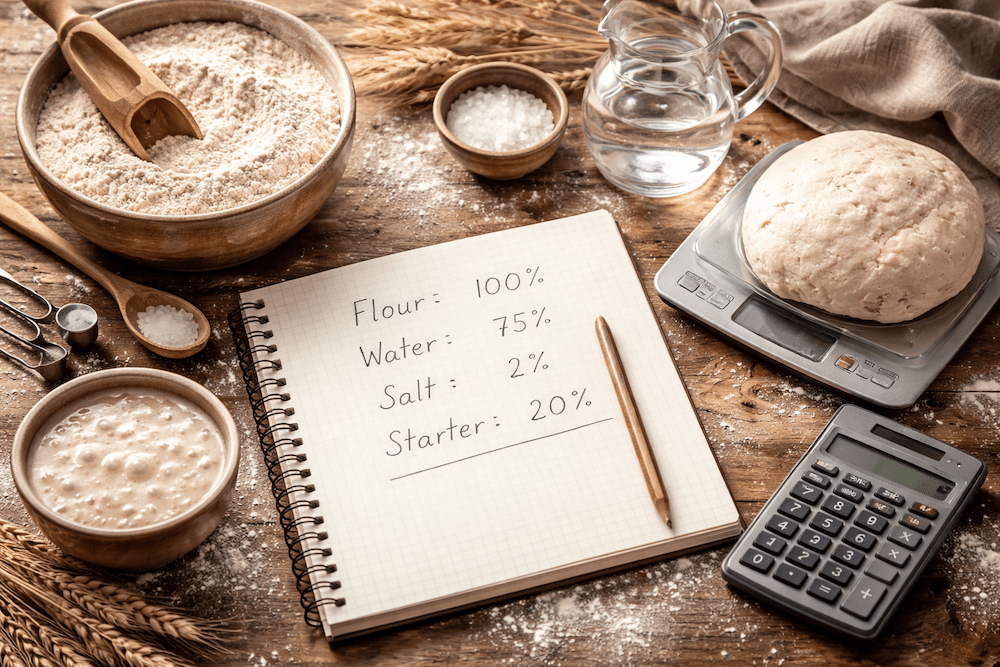
Baker’s math (also called baker’s percentages) is one of the most useful tools a bread baker can learn. It removes guesswork from recipes and makes it easy to scale formulas, adjust hydration, or compare different breads. Once you understand the concept, nearly every professional bread formula suddenly becomes easy to read.
What baker’s math is
In baker’s math, every ingredient is expressed as a percentage of the total flour weight.
The flour is always defined as 100%.
All other ingredients are calculated relative to that flour weight.
Example:
Flour: 100%
Water: 70%
Salt: 2%
Starter: 20%
This means the amount of each ingredient is a percentage of the flour weight, not the total dough weight.
Why this matters
Most home recipes are written in fixed weights or volumes. That works fine if you want exactly one loaf, but it becomes awkward when you want to:
• make a larger batch
• adjust hydration
• compare recipes
• maintain consistency
Baker’s math solves this problem because the proportions stay constant regardless of batch size.
Example 1: A simple sourdough formula
Let’s start with a basic sourdough bread formula written in baker’s percentages.
Flour: 100%
Water: 72%
Salt: 2%
Sourdough starter (100% hydration): 20%
Now choose a flour weight. Suppose you want to use 500 g of flour.
Flour
500 g × 100% = 500 g
Water
500 g × 72% = 360 g
Salt
500 g × 2% = 10 g
Starter
500 g × 20% = 100 g
Your dough becomes:
500 g flour
360 g water
10 g salt
100 g starter
The total dough weight is 970 g.
Example 2: Scaling the same formula
Now imagine you want two loaves instead of one. Instead of rewriting the recipe, you simply change the flour amount.
Let’s use 900 g flour.
Flour
900 g
Water
900 × 0.72 = 648 g
Salt
900 × 0.02 = 18 g
Starter
900 × 0.20 = 180 g
Your dough becomes:
900 g flour
648 g water
18 g salt
180 g starter
The proportions remain identical, but the dough size increased.
Example 3: Understanding hydration
Hydration is the ratio of water to flour.
Hydration = water percentage
If a formula contains:
Flour: 100%
Water: 70%
the dough is called a 70% hydration dough.
Hydration strongly influences the character of bread.
60–65% hydration
Firm dough, easier shaping, tighter crumb
70–75% hydration
Moderately open crumb, typical artisan bread
80%+ hydration
Very open crumb, difficult handling
Example:
Flour: 100%
Water: 80%
Salt: 2%
With 500 g flour:
Water = 400 g
Salt = 10 g
This dough will feel significantly wetter than a 65% dough.
Example 4: Preferments and starter
When sourdough starter is used, it contains both flour and water. In baker’s math, the starter is usually expressed as a percentage of flour, but the hydration of the starter must also be considered.
Assume:
Starter: 20%
Starter hydration: 100%
A 100% hydration starter contains equal parts flour and water.
If you add 100 g starter, you are actually adding:
50 g flour
50 g water
Professional formulas sometimes list preferment flour separately to make this clearer.
Example 5: Converting a traditional recipe
Suppose a recipe says:
500 g flour
350 g water
10 g salt
To convert this to baker’s math:
Flour = 100%
Water percentage
350 ÷ 500 = 0.70
Water = 70%
Salt percentage
10 ÷ 500 = 0.02
Salt = 2%
The formula becomes:
Flour: 100%
Water: 70%
Salt: 2%
Now the recipe can be scaled to any size instantly.
Example 6: Calculating dough weight
Sometimes you know the final dough weight you want rather than the flour weight.
Suppose you want a 1,000 g dough using this formula:
Flour: 100%
Water: 70%
Salt: 2%
First calculate the total percentage.
100 + 70 + 2 = 172%
Now divide the desired dough weight by the total percentage.
1000 ÷ 1.72 = 581 g flour
Then calculate the other ingredients.
Water
581 × 0.70 ≈ 407 g
Salt
581 × 0.02 ≈ 12 g
Final dough:
581 g flour
407 g water
12 g salt
Total ≈ 1000 g
Why professionals use baker’s math
Baker’s math allows professional bakeries to:
• maintain consistent recipes
• adjust production volume quickly
• experiment with formulas
• communicate recipes clearly
Once you begin thinking in percentages instead of fixed weights, bread formulas become far easier to understand.
A final thought
At first, baker’s math may look unnecessarily technical for something as simple as bread. But in practice it does the opposite: it simplifies baking.
Instead of memorizing recipes, you begin to understand relationships.
Flour, water, salt, fermentation — just numbers that describe how a dough behaves.
And once you see bread that way, you can adjust it to your own kitchen, schedule, and taste.
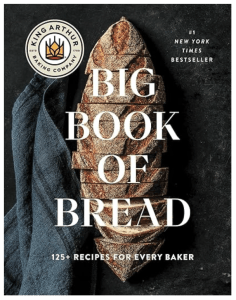 The King Arthur Baking Company Big Book of Bread
Authoritative yet approachable, The King Arthur Baking Company Big Book of Bread stands out for both its scope and clarity. The book presents 125 recipes covering yeasted breads and naturally leavened loaves, designed to guide complete beginners while still offering depth and inspiration for experienced bakers—including those deeply invested in sourdough.
Beyond recipes, the book functions as a practical guide to the craft of bread baking. It explains essential techniques such as folding, shaping, and managing fermentation, while also addressing the fundamentals of flour, yeast, hydration, and temperature. Helpful guidance is included for working with difficult doughs and for storing different types of bread so they stay fresh as long as possible. Each recipe is accompanied by a full-color photograph, and the instructional sections include step-by-step photography. QR codes throughout the book link to short instructional videos, adding a modern learning component to the traditional cookbook format. An elegant ribbon marker rounds out the presentation.
At the heart of the book is an unusually broad and inclusive collection of breads from around the world. The recipes range from everyday staples to celebratory baking projects, including:
Flatbreads: Focaccia, Naan, Pita, Scallion Pancake, Lavash, Seedy Crackers
Pan Loaves: Everyday Bread, English Muffin Toasting Bread, Tiger Milk Bread
Sourdough: Baguette, Sandwich Bread, Cinnamon Swirl
Hearth Breads: Classic Miche, Chocolate Levain, Sesame Whole Wheat Loaf
Buns, Bagels, and Rolls: Conchas, Bolo Bao, Jerusalem Bagels, Buttermilk Buns
“Fancy” Breads: Basic Babka, Big Sticky Bun, Stollen
Things to Make with Bread: Cheddar Kimchi Strata, Sourdough Lasagna, Migas
The result is a comprehensive baking reference that manages to demystify bread making without oversimplifying it. Beginners will find clear instruction and encouragement, while experienced bakers will discover new techniques, recipes, and ideas to expand their repertoire. More information…
