

If you’ve spent enough time around sourdough forums, you’ve probably seen it:
someone casually mentioning they measured their dough at “pH 4.3” like it’s the most normal thing in the world.
At first glance, it sounds like baking has officially crossed into laboratory territory. Beakers next to bannetons. White coats next to aprons.
But the truth is a little less dramatic—and a lot more useful.
Let’s break it down.
So… what is pH, really?
pH is just a number that tells you how acidic something is.
- 7 is neutral
- Lower than 7 is acidic
- Higher than 7 is alkaline
Sourdough, as it turns out, is very interested in becoming acidic. That’s because of the tiny workforce inside your dough: wild yeast and, more importantly, lactic acid bacteria.
These bacteria happily munch on sugars and produce acids as a byproduct. That’s what gives sourdough its signature flavor—and a whole lot more.
Why acidity matters more than you think
Most people associate acidity with taste. And yes, that’s part of the story.
But it goes deeper.
1. Flavor: the obvious benefit
Lower pH = more acid = more tang
Higher pH = milder, softer flavor
That classic sourdough bite? That’s acidity doing its thing.
2. Dough strength: the quiet balancing act
This is where things get interesting.
- A little acidity strengthens gluten
- Too much acidity starts breaking it down
In other words, acidity is both your best friend and your worst enemy.
Get it right, and you have a dough that holds shape beautifully.
Push it too far, and you’re dealing with a sticky, slack mess that refuses to cooperate.
3. Fermentation: the hidden timeline
As your dough ferments, the pH steadily drops.
And that drop isn’t just a number—it reflects what’s happening inside the dough:
- Microbial activity shifts
- Enzymes get more active
- Structure begins to change
Some bakers rely on pH because it tells them exactly where they are in the process—regardless of whether their kitchen is 65°F in winter or 78°F in summer.
Time can lie. pH usually doesn’t.
What numbers are we talking about?
Here’s a rough guide:
- Fresh dough: around 5.5–6.0
- Mid fermentation: 4.5–5.0
- Fully fermented: 3.8–4.3
Once you dip into the lower end, you’re getting close to over-fermentation—the point where structure starts to give up the fight.
So why do some bakers measure it?
Because they want consistency.
A pH meter gives them a way to:
- Dial in fermentation with precision
- Repeat results across different days and seasons
- Compare flours and techniques objectively
- Avoid the “was it over or under?” guessing game
It’s less about being scientific for the sake of it—and more about removing uncertainty.
Do you need a pH meter?
Not even remotely.
Great sourdough has been baked for thousands of years without anyone checking acidity levels.
You can rely on:
- Dough feel
- Volume increase
- Surface bubbles
- Experience (the underrated one)
A pH meter doesn’t replace these—it just confirms them.
The real takeaway
pH is not the goal.
No one bites into a loaf and says, “Ah yes, a perfect 4.2.”
What they do notice is balance:
- Flavor that’s present but not overwhelming
- Structure that holds but isn’t tough
- A crumb that feels alive, not collapsed
pH is simply a way to see that balance instead of relying entirely on instinct.
And if you prefer instinct?
You’re in very good company.
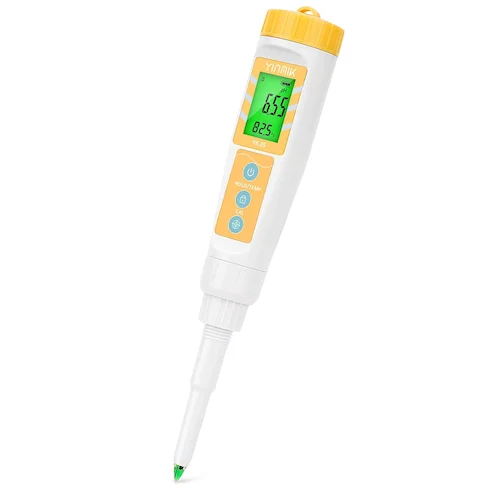 YINMIK pH Meter for Sourdough and Food Fermentation
The YINMIK pH meter is designed for bakers and fermentation enthusiasts who want to monitor acidity with greater precision. Equipped with a proprietary spear-style probe, it is particularly well suited for measuring the pH of sourdough dough during bulk fermentation without the need for slurry preparation.
Beyond bread baking, the meter is versatile enough for a wide range of fermentation applications, including sausages, salami, cheese, sushi rice, canned jams, fermented sauces, hot sauces, and salsa. With a measurement range of 0.00–14.00 pH and an accuracy of ±0.1 pH, it offers sufficient precision for most culinary and fermentation uses.
The spear probe design also makes it useful for cosmetic applications such as lotions and creams, allowing direct insertion into semi-solid samples for quick readings.
To improve reliability, the unit features enhanced internal electronics for more stable measurements and includes Automatic Temperature Compensation (ATC) to help maintain accuracy across varying ambient temperatures. Its protective cap contains a KCl-soaked sponge to keep the probe moist during storage, helping extend probe life.
Calibration is straightforward thanks to the built-in three-point auto-calibration function. The package includes six buffer solution packets, providing enough calibration solution for repeated long-term use. More information…
